


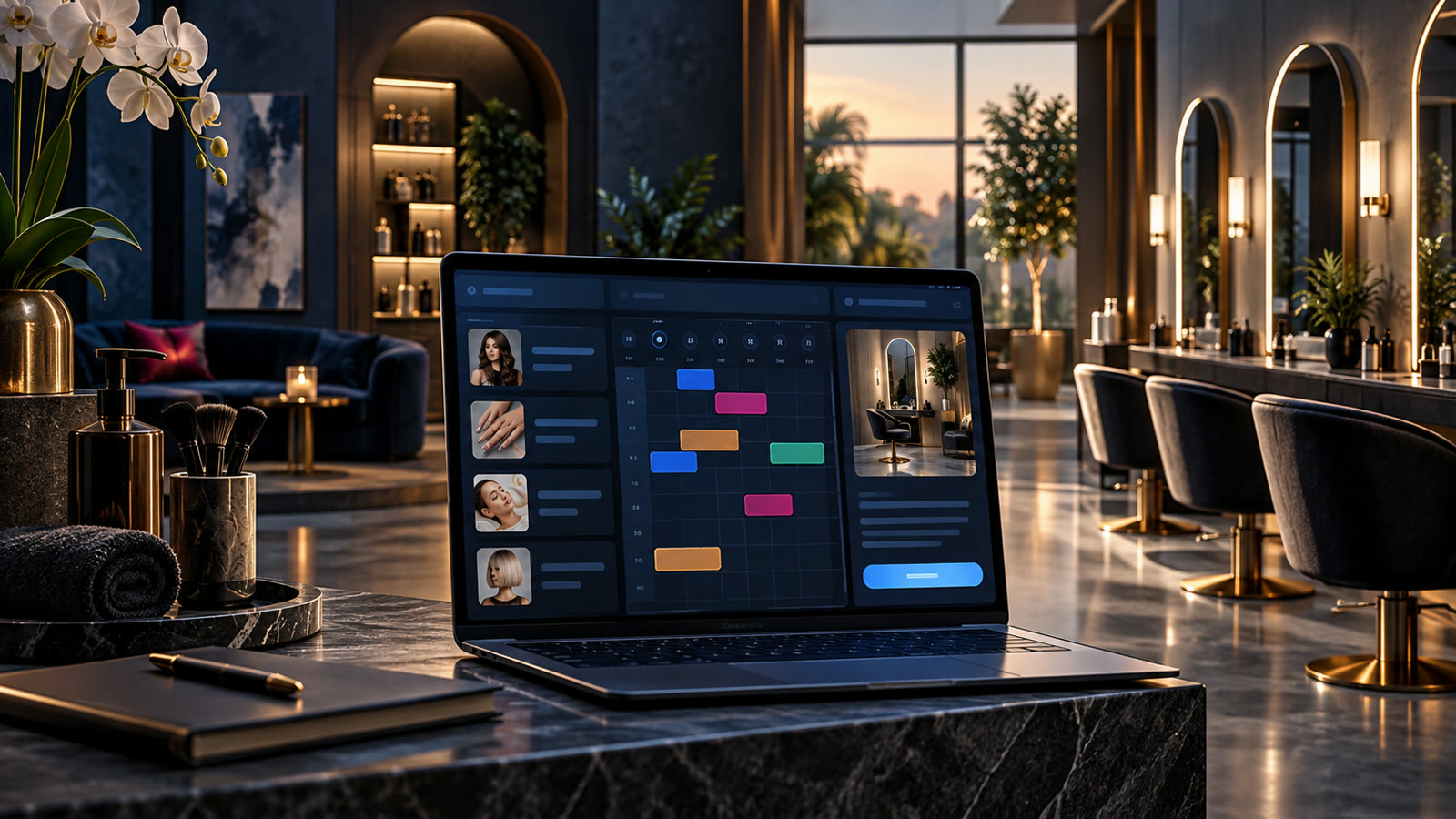
Most salon sites look good and still hand the booking to the salon listed right below them in search results. Alpha Efficiency is a Chicago web design and AI development team that builds conversion-first salon sites for solo stylists and multi-chair salons, wired for the booking moment. Here is what most salons miss when they redesign. Book a call with us. See our work.
What a Weak Salon Site Costs You Every Month
Every month, a weak booking funnel turns into appointments paid to another salon. Three quiet losses tend to add up:
- Paid traffic burns out faster on a low-converting site.
- Organic rankings stall when the architecture works against the content.
- Referrals leak when a friend searches your salon and finds a site that feels stale. A site that ranks well and books poorly becomes a slow tax on every marketing dollar your salon spends.
Step 1: Find Where Your Site Loses Bookings
Most people land on your site on a phone, with a few seconds to decide. If the page loads slowly or the booking button is hard to find, they tap the next result. That is where ad spend disappears and referrals turn into someone else’s appointments. Before any design work begins, audit three things:
- Hero load time on a mid-range Android phone.
- Where the booking button and mobile navigation sit, above or below the fold.
- The questions your service pages answer in the first 200 words. A handful of newly booked chairs can cover the cost of the redesign in a single season, so each item on that audit list earns its place.
Step 2: Build the Structure Around the Booking Moment
You can pay for a polished design, tick every SEO box, and still watch the booking page sit quiet. The fix is structural. Four shifts change how a beauty salon website design performs:
- Every section moves the visitor toward booking, whether a tap or a form.
- Trust signals show up early, where hesitation is highest.
- Content answers the questions clients search for at 11 pm.
- Page speed is treated as part of conversion engineering. When the structure prioritizes booking, SEO follows. That is the through-line of how we work as a Chicago web design agency.
Step 3: Build Pages That Match How Clients Decide
The visitor on your site is one click away from leaving. They are scanning for proof that your salon handles their hair, skin, or color type, and for a way to book without a phone call. Apply five design choices to every page on the site:
- Plain language that matches how clients describe what they want.
- Real photos of your stylists and finished looks, placed where doubt peaks.
- Stylist bios that feel human and bookable.
- Service pages that use the words clients use in search.
- Mobile layouts that load fast, even on an older phone with a weak signal. Each page should answer the question that brought the visitor in and make the next step obvious. Pair the site with the salon marketing strategies you already lean on, so the channels feed the same booking page.
Step 4: SEO Starts in the Wireframes
A salon site lives or dies in local search, where most clients first find you. By the time bookings drop, the site’s architecture is usually working against the content, and a surface refresh will not fix it. Set the SEO foundation while the site is still in wireframes:
- Keyword research mapped to services, hair types, and neighborhood targeting.
- URL and internal linking structure designed for topical authority across services.
- On-page optimization wired into every template before visual design begins.
- Schema markup for services, stylists, and reviews.
- Technical SEO baked into the build, not bolted on later.
- Local SEO support for salons competing within one metro area. A solid foundation in local search compounds with every new client search for your services.
Step 5: A Six-Stage Build You Can Follow
Handing over the most visible asset of your salon is a real decision, and you deserve to know what to expect at every stage. Our workflow keeps you in the loop without taking over your week. The build moves in six defined stages:
- Discovery and brand audit. We map your service mix, stylists, booking software, and existing reviews.
- Architecture and wireframes. You see the structure before any visual design begins.
- Design and content. Pages are written and designed using Figma for web design, with your input on voice and proof.
- Development and SEO. The site is built with performance, accessibility, and search visibility as baseline requirements.
- QA, launch, and handoff. We migrate, redirect, and watch traffic so rankings carry over without dropping.
- Post-launch tuning. We watch the data and refine pages that underperform. Every stage has a checkpoint, so you know where the project stands and what is being asked of you.
Step 6: Connect Booking to Your Workflow
A new site has to plug into the way your front desk runs, or your team will route around it. Two connections decide whether the build pays off:
- Booking software is integrated with the site via forms, click-to-call, and tracking, so a new client lands in the tools your team already uses.
- Reporting is tied to booked appointments, not vanity traffic, so you can see what the site earns each month. This is the step where most salon rebuilds fall short. A site that looks better than the old one but does not talk to your booking tool gives you a redesign, not a marketing asset.
Design That Reads as Credibility
Design carries part of the trust your salon depends on. A site that feels current, calm, and confident tells the visitor that the chairs behind it operate the same way. Five design choices do most of that work:
- Typography that holds attention through longer service pages.
- Photography that feels grounded and real, not stock.
- Color systems that read well on every device, including older phones.
- Layouts that guide the eye toward the next useful action.
- Visual hierarchy that lets a busy visitor find what they need in seconds. A salon website signals what the chairs behind it feel like before a client walks through the door. Yours should look like a salon a friend would recommend without hesitation, with the polish of modern UI design.
What Your Homepage Has to Prove in Five Seconds
A client lands on your homepage, scans for a few seconds, and decides whether to book or back out. Four signals carry that decision:
- You offer the service they came for.
- Your salon feels current and well kept.
- Booking is one tap away on mobile.
- The next step is obvious without reading a paragraph. We design the first screen around clear copy, a visible booking button, and early trust signals, in line with current design trends.
Fit for Solo Stylists and Multi-Chair Salons
Your site should match the size of your salon today and stretch with the one you are building next year. A good build scales with you, so you are not forced into a redesign when you add a chair, a location, or a new service line.
- Solo stylists and suite renters get a focused site, a simple booking flow, and service pages that match the looks you want to be known for.
- Multi-chair salons and groups get stylist directories, deeper service hubs, and location pages with booking routing by service or by stylist.
Your Next Salon Website Starts With a Call
Your salon has chairs to fill, and the right beauty salon website design should make that easier every month. Alpha Efficiency builds salon sites that look the part, rank in your neighborhood, and earn a central place in your marketing. On a short call, we review your current site, your booking flow, and the salon’s ranking in your area, then map the shortest path to a fuller calendar. Take a look at our portfolio to see the kind of work we deliver. When you want to talk through your site, book a call with us.
Related website strategy resources
- Online marketing for beauty salons
- How web design builds trust
- Website conversion funnels
- Website design cost calculator
FAQs: Beauty Salon Website Design
1. How long does a new beauty salon website design take to launch?
Most salon builds we have shipped over the past year run between four and eight weeks from kickoff to launch. The timeline depends on how many service pages you need, how many stylists you want featured, and how fast feedback moves on your side.
2. Can you integrate the new site with our existing booking software?
Yes. We design around the booking software your team already uses, so your front desk workflow stays familiar. If you are open to a switch, we can walk through what would work for your salon.
3. Will the new beauty salon website work on mobile?
Every layout we build is designed for mobile first. That includes the homepage, service pages, stylist pages, gallery, and the booking flow. Most salon traffic comes through phones, so the small screen is where we start.
4. What if we do not have professional photos of our salon?
We work with what you have. If your current photos are holding the brand back, we help you plan a focused shoot. A modest session covering your interior, your stylists, and finished looks goes a long way on a salon homepage.
5. Will our salon site show up on Google after the redesign?
We build with clean SEO foundations baked into the structure, copy, and metadata. Visibility grows as Google revisits the site. Ongoing SEO is available as a separate engagement for salons seeking faster traction.
6. Can you write the copy for our service pages and stylist bios?
Yes. We write copy that sounds like your salon and matches how your clients talk about their hair, color, or skin. You review every word before it goes live.
7. What happens once the site is live?
For the first 90 days, we tune the site against real visitor behavior. We track booking clicks, calls, and rankings, then refine the pages that underperform. Salons can keep us involved for ongoing SEO, content, or design after that window closes.
8. Do you redesign or build salon sites from scratch?
Both. Many engagements begin as redesigns of sites that look fine and fail to convert, or sites that have aged out of current standards. We audit what is working, preserve the equity, and rebuild around a booking-first structure.
9. What if our salon serves multiple neighborhoods or locations?
We build location structures for salons serving multiple neighborhoods, suburbs, or cities. Each location gets a dedicated page with local search signals, while the wider site keeps one consistent brand and booking flow.